
What is One Drop?*
- All human beings share the same blood
- The majority of pop culture has African origins, whether it’s jazz, blues, R'n'B, rock, funk, soul, reggae, hip-hop, drum'n'bass, Latin music, or others.
*»feel it in the one drop...« (Bob Marley)
The history of popular music in the 20th century demonstrates that our listening habits are shaped by African sounds. Most people are no longer consciously aware of this. ONE DROP brings it back to mind. (Our grandparents were right when they called it “jungle music”...)
WARNING: All artists and bands that play reggae or African music are always warmly invited to introduce themselves and their music to me. (Of course, you don’t have to be physically present...). If anyone knows bands/artists that should be featured, I kindly ask for recommendations!!!
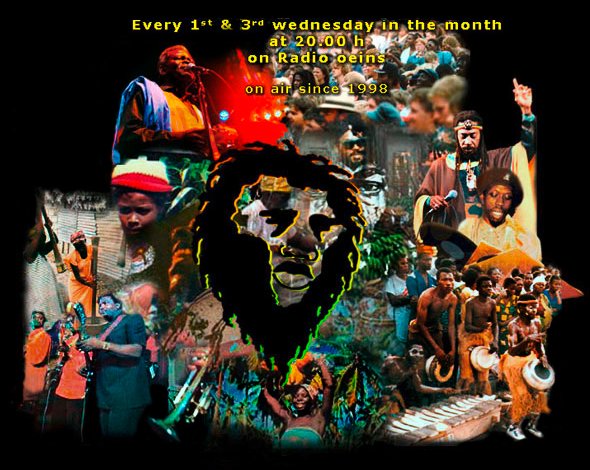
What’s to listen to?
- Regarding Africa, I have now learned and delved into much more than just the music from the Maghreb – everything happening north of the Sahara. This includes Senegambian Mbalax and other sounds, old and new music from Mali, Guinea, and beyond; a lot of old and new Highlife from West Africa, from Guinea to Nigeria; of course the famous Nigerian Afrobeat (not just Fela Kuti!), as well as Juju and Fuji; the music of Côte d'Ivoire and Angola; various styles from Cameroon; a lot of South African music, including its widespread choir music; a great deal of old (= Congolese Rumba) and new music (=Zoukous) from the Congo; as well as East African styles from Kenya, Zimbabwe to Madagascar, plus reggae and contemporary music from different African countries, increasingly developing into House and Hip-Hop. I now try to stay as current as possible, mainly presenting contemporary African music. But that’s by no means only what is heard as “Afrobeats” in the “West”. Much of it nowadays sounds hardly different from European or US pop. Depending on personal taste, this is also a consequence of "globalism" and cultural exchange. I also try to break through masculine dominance. Therefore, sometimes entire shows feature only music by women; occasionally, there are full programmes with female hip-hop artists from South Africa or elsewhere.
In Germany, it remains difficult to find good African music. In many cities and shops, sellers are often very uninformed or uninterested. The market outside Germany is huge: as early as in the two volumes of R. Graham’s "Stern's Guide to Contemporary African Music," Vol I and II, 1988 and 1992, about 10,000 LPs are listed; Graham also estimated that in the 20th century, around 100,000 singles were produced; some African stars have released around 200 LPs over 30 years; Africa’s biggest hit "Sweet Mother" by Nico Mbarga sold approximately 25 million copies in ten years.
Content-wise, I often dedicate a show, sometimes over several weeks, to a specific region and/or its musical styles: the continent and its culture are very diverse.
Only in recent years have newcomers in clubs and radio started discovering such music. However, many, including some presenters and promoters, still mix everything up by grouping it all under an imaginary umbrella or labelling it with flat style tags (“world music”). This does little to help fans understand and does not benefit the music. - Regarding Reggae, I have now introduced all forms: from Ska, Rocksteady, and early toasters (=rappers; rap emerged on Jamaica 10 years before US rap), through 80s Rub-a-Dub, to the latest roots and dancehall. Occasionally, there’s also Soca, Calypso, or Mento.
Since Germany has become, alongside Jamaica (and the USA), almost the most important reggae market, I have focused on German reggae productions for several years. Firstly, I am very curious about what’s happening here, and secondly, the quality of German reggae productions is improving all the time. Without (what I already dislike) patriotic bias, I believe it’s worth paying attention to German reggae (and not just sticking with Gentleman). Additionally, reggae often explores themes such as Jamaican Patois, Africanism, war, love, cannabis, or Christmas.
Every year on “International Women’s Day,” there’s reggae (and African pop) performed solely by female artists, which is typically male-dominated. For special occasions like birthdays or memorial days, I also feature individual artists. (I’ve dedicated four shows to my favourite Dennis Brown over time.) I also promote artists currently performing in the Oldenburg region.
Since about a year, I’ve added a new feature called “Foundation Time” to each show. In it, I present two or three “forgotten” or little-known pieces of music history to make them accessible to younger listeners or to remind older ones.
And what else?
- I have hosted studio guests from Jamaica, Germany, Gambia, Senegal, Ghana, Ivory Coast, Cameroon, Côte d'Ivoire, Nigeria, Brazzaville, Congo, Mozambique, Tanzania, South Africa, and Russia.
On the go, during concerts, and in the studio, I have conducted interviews with: Miriam Makeba, Junior Murvin, Dawn Penn, Stichie, Charlie Chaplin, Jasper van Hofft, Bernd "Sheriff" Lagemann, Sista Gracy, Ganjaman, Uwe Banton, Spruddy One, Mono & Nikitaman, Mellow Mark, Dr. Ring Ding, Jahcoustix, Nattyflo, Jah Meek, Brain Damage, Sam Gilly, Nosliw, Zion Train, Earl 16, Sebastian Sturm, Jamaram, Conscious Fire, Manu Ranking, Raggabund, Uwe K., Curvin Murchin, Lady N., and many others. - Archive
The PLAYLIST is very extensive after 28 years of radio work. By August 2026, over 6900 tracks have been played (the exact number of tracks is no longer known. In the archive, I have recorded 5400 tracks so far, but this is incomplete because I can no longer trace many earlier playlists). These have been played across more than 670 productions, including around 2700 African titles, with the rest being reggae, a few Zouk or Soca tracks. Unfortunately, I haven’t recorded everything in the archive, so the actual number is probably much higher.
I am happy to give discographic tips to interested parties and am keen on exchanging information or music seriously ;-) - In earlier years, I photographed concerts; after a break, since 2006, I have been increasingly taking concert photos, which can be seen on various websites. See the Links.
- The show is pre-produced. Nevertheless, I try to include current news of general interest, such as conflicts in Africa. And since ONE DROP can now be received via the internet, listeners are on all continents (as shown by the feedback on social media). Therefore, I often present bilingually in English and German.
