
Privacy Policy
Table of Contents
- Introduction and Overview
- Scope of Application
- Legal Basis
- Contact Details of the Data Controller
- Data Retention Period
- Rights under the General Data Protection Regulation
- Security of Data Processing
- Communication
- Data Processing Agreement (DPA)
- Cookies
- Web Hosting Introduction
- Cloud Services
- Conclusion
Introduction and Overview
We have written this privacy policy (version 04.09.2025-323049738) to explain to you, in accordance with the requirements of the General Data Protection Regulation (EU) 2016/679 and applicable national laws, which personal data (hereinafter referred to as data) we, as the data controller, process – and the data processors commissioned by us (e.g., providers) – process, will process in the future, and what legal options you have. The terms used are to be understood as gender-neutral.
In short: We provide you with comprehensive information about the data we process about you.
Data protection declarations usually sound very technical and use legal jargon. This data protection declaration, however, aims to describe the most important things to you as simply and transparently as possible. Wherever it promotes transparency, technical terms are explained in a reader-friendly way, links to further information are provided, and graphics are used. We thus inform you in clear and simple language that, in the course of our business activities, we only process personal data if there is a corresponding legal basis. This is certainly not possible if one provides explanations that are as brief, unclear, and legally technical as possible, as is often the standard on the internet when it comes to data protection. I hope you find the following explanations interesting and informative, and perhaps there is some information that you were not yet aware of.
If you still have questions, we ask you to contact the responsible party mentioned below or in the imprint, to follow the links provided, and to view further information on third-party websites. Our contact details can also be found in the imprint.
Scope of Application
This data protection declaration applies to all personal data processed by us in the company and to all personal data processed by companies commissioned by us (data processors). By personal data, we mean information within the meaning of Art. 4 No. 1 GDPR, such as the name, email address, and postal address of a person. The processing of personal data ensures that we can offer and bill for our services and products, whether online or offline. The scope of this privacy policy includes:
- all online presences (websites, online shops) that we operate
- social media presences and email communication
- mobile apps for smartphones and other devices
In short: This privacy policy applies to all areas in which personal data is processed in a structured manner within the company via the channels mentioned above. Should we enter into legal relationships with you outside of these channels, we will inform you separately if necessary.
Legal Basis
In the following privacy policy, we provide you with transparent information about the legal principles and regulations, i.e., the legal basis of the General Data Protection Regulation (GDPR), which allows us to process personal data.
Regarding EU law, we refer to REGULATION (EU) 2016/679 OF THE EUROPEAN PARLIAMENT AND OF THE COUNCIL of 27 April 2016. You can, of course, read this EU General Data Protection Regulation online on EUR-Lex, the access point to EU law, at https://eur-lex.europa.eu/legal-content/DE/ALL/?uri=celex%3A32016R0679.
We process your data only if at least one of the following conditions applies:
- Consent (Article 6 paragraph 1 lit. a GDPR): You have given us your consent to process data for a specific purpose. An example would be the storage of the data you entered in a contact form.
- Contract (Article 6 paragraph 1 lit. b GDPR): We process your data in order to fulfill a contract or pre-contractual obligations with you. For example, if we conclude a purchase agreement with you, we require personal information beforehand.
- Legal obligation (Article 6 paragraph 1 lit. c GDPR): If we are subject to a legal obligation, we process your data. For example, we are legally obliged to keep invoices for accounting purposes. These usually contain personal data.
- Legitimate interests (Article 6 paragraph 1 lit. f GDPR): In the case of legitimate interests that do not restrict your fundamental rights, we reserve the right to process personal data. For example, we need to process certain data in order to operate our website securely and economically efficiently. This processing is therefore a legitimate interest.
Other conditions such as the performance of tasks carried out in the public interest and the exercise of official authority, as well as the protection of vital interests, generally do not apply to us. If such a legal basis should nevertheless be applicable, it will be indicated in the corresponding section.
In addition to the EU regulation, national laws also apply:
- In Austria, this is the Federal Act on the Protection of Natural Persons with regard to the Processing of Personal Data (Data Protection Act), or DSG for short.
- In Germany, the Federal Data Protection Act, or BDSG for short, applies.
If further regional or national laws apply, we will inform you about them in the following sections.
Contact details of the data controller
Should you have any questions about data protection or the processing of personal data, you will find the contact details of the data controller below in accordance with Article 4, paragraph 7 of the EU General Data Protection Regulation (GDPR):
Karl-Heinz Peisker
Authorized representative: Karl-Heinz Peisker
Email: one-drop@freenet.de
Phone: +4917638485092
Imprint: https://www.onedrop-radio.de/impressum.html
Storage period
A general criterion for us is that we only store personal data for as long as it is absolutely necessary for the provision of our services and products. This means that we delete personal data as soon as the reason for the data processing no longer exists. In some cases, we are legally obligated to store certain data even after the original purpose has ceased to exist, for example, for accounting purposes. If you wish to have your data deleted or revoke your consent to data processing, the data will be deleted as quickly as possible, provided there is no obligation to store it. We will inform you about the specific duration of the respective data processing below, provided we have further information on this.
Rights according to the General Data Protection Regulation
According to Articles 13 and 14 of the GDPR, we inform you about the following rights that you have in order to ensure fair and transparent data processing:- According to Article 15 of the GDPR, you have the right to information about whether we process your data. If this is the case, you have the right to receive a copy of the data and to learn the following information:
- the purpose for which we carry out the processing;
- the categories, i.e., the types of data that are processed;
- who receives this data and, if the data is transferred to third countries, how security can be guaranteed;
- how long the data will be stored;
- the existence of the right to rectification, erasure, or restriction of processing and the right to object to the processing;
- that you can lodge a complaint with a supervisory authority (links to these authorities can be found below);
- the origin of the data if we did not collect it from you;
- whether profiling is carried out, i.e., whether data is automatically evaluated in order to arrive at a personal profile of you.
- According to Article 16 of the GDPR, you have the right to rectification of data, which means that we must correct data if you find errors.
- According to Article 17 of the GDPR, you have the right to erasure ("right to be forgotten"), which specifically means that you may request the deletion of your data.
- According to Article 18 of the GDPR, you have the right to restriction of processing, which means that we may only store the data but not use it further.
- According to Article 20 of the GDPR, you have the right to data portability, which means that we will provide you with your data in a common format upon request.
- According to Article 21 of the GDPR, you have the right to object, which, if exercised, will result in a change to the processing.
- If the processing of your data is based on Article 6 paragraph 1 letter e (public interest, exercise of official authority) or Article 6 paragraph 1 letter f (legitimate interest), you can object to the processing. We will then examine as quickly as possible whether we can legally comply with this objection.
- If data is used for direct marketing, you can object to this type of data processing at any time. We may then no longer use your data for direct marketing.
- If data is used for profiling, you can object to this type of data processing at any time. We may then no longer use your data for profiling.
- According to Article 22 of the GDPR, you may have the right not to be subject to a decision based solely on automated processing (e.g., profiling).
- According to Article 77 of the GDPR, you have the right to lodge a complaint. This means that you can complain to the data protection authority at any time if you believe that the processing of personal data violates the GDPR.
In short: You have rights – Please do not hesitate to contact the responsible body listed above!
If you believe that the processing of your data violates data protection law or that your data protection rights have been violated in any other way, you can file a complaint with the supervisory authority. In Austria, this is the Data Protection Authority, whose website you can find at https://www.dsb.gv.at/. In Germany, there is a data protection officer for each federal state. For more information, you can contact the Federal Commissioner for Data Protection and Freedom of Information (BfDI). The following local data protection authority is responsible for our company:
Lower Saxony Data Protection Authority
State Commissioner for Data Protection: Denis Lehmkemper
Address: Prinzenstraße 5, 30159 Hanover
Phone number: 05 11/120-45 00
Email address: poststelle@lfd.niedersachsen.de
Website:
https://lfd.niedersachsen.de/startseite/
Security of Data Processing
To protect personal data, we have implemented both technical and organizational measures. Wherever possible, we encrypt or pseudonymize personal data. This makes it as difficult as possible, within our capabilities, for third parties to deduce personal information from our data.
Article 25 of the GDPR refers to "data protection by design and by default" and means that security should always be considered and appropriate measures implemented for both software (e.g., forms) and hardware (e.g., access to the server room). Below, we will discuss specific measures in more detail, where necessary.
TLS Encryption with HTTPS
TLS, encryption, and HTTPS sound very technical, and they are. We use HTTPS (the Hypertext Transfer Protocol Secure) to transmit data securely over the internet.
This means that the entire transmission of all data from your browser to our web server is secured – nobody can "eavesdrop".
With this, we have introduced an additional layer of security and comply with data protection by design (Article 25, paragraph 1 of the GDPR). By using TLS (Transport Layer Security), an encryption protocol for secure data transmission on the internet, we can ensure the protection of confidential data.
You can recognize the use of this data transmission security by the small padlock symbol  in the upper left corner of your browser, to the left of the internet address (e.g., examplesite.de) and the use of the https scheme (instead of http) as part of our internet address.
If you would like to know more about encryption, we recommend searching Google for "Hypertext Transfer Protocol Secure wiki" to find good links to further information.
Communication
|
Communication Summary
👥 Affected parties: Everyone who communicates with us by telephone, email or online form 📝 Processed data: e.g., telephone number, name, email address, entered form data. More details can be found under the respective contact method used. 🤝 Purpose: Processing communication with customers, business partners, etc. 📅 Storage period: Duration of the business case and legal requirements ⚖️ Legal basis: Art. 6 para. 1 lit. a GDPR (consent), Art. 6 para. 1 lit. b GDPR (contract), Art. 6 para. 1 lit. f GDPR (legitimate interests) |
If you contact us and communicate by telephone, email or online form, personal data may be processed.
The data is processed for the handling and processing of your inquiry and the related business transaction. The data is stored for as long as the business case is ongoing or as long as required by law.
Affected persons
All those who contact us via the communication channels provided by us are affected by the processes mentioned.
Telephone
When you call us, the call data is stored pseudonymously on the respective device and with the telecommunications provider used. In addition, data such as name and telephone number may subsequently be sent by email and stored for answering the inquiry. The data will be deleted as soon as the business case has been completed and legal requirements permit.
If you communicate with us by email, data may be stored on the respective device (computer, laptop, smartphone, etc.) and data will be stored on the email server. The data will be deleted as soon as the business case has been completed and legal requirements permit it.
Online Forms
If you communicate with us using an online form, data will be stored on our web server and, if applicable, forwarded to one of our email addresses. The data will be deleted as soon as the business case has been completed and legal requirements permit it.
Legal Basis
The processing of the data is based on the following legal grounds:
- Art. 6 para. 1 lit. a GDPR (Consent): You give us your consent to store your data and to use it further for purposes related to the business case;
- Art. 6 para. 1 lit. b GDPR (Contract): It is necessary for the performance of a contract with you or a data processor such as the telephone provider, or we need to process the data for pre-contractual activities, such as preparing a quote;
- Art. 6 para. 1 lit. f GDPR (Legitimate Interests): We want to conduct customer inquiries and business communication in a professional manner. This requires certain technical facilities such as email programs, Exchange servers, and mobile phone providers in order to be able to conduct communication efficiently.
Data Processing Agreement (DPA)
In this section, we would like to explain what a data processing agreement is and why it is needed. Because the word "data processing agreement" is quite a tongue twister, we will often use the acronym DPA in this text. Like most companies, we do not work alone, but also use the services of other companies or individuals. By involving various companies or service providers, we may pass on personal data for processing. These partners then act as data processors, with whom we conclude a contract, the so called data processing agreement (DPA). Most importantly for you to know is that the processing of your personal data is carried out exclusively according to our instructions and must be regulated by the DPA.
Who are data processors?
As a company and website owner, we are responsible for all data that we process from you. In addition to the data controllers, there may also be so-called data processors. This includes any company or person who processes personal data on our behalf. More precisely, and according to the GDPR definition: any natural or legal person, public authority, agency or other body that processes personal data on our behalf is considered a data processor. Data processors can therefore be service providers such as hosting or cloud providers, payment or newsletter providers, or large companies such as Google or Microsoft.
To better understand the terminology, here is an overview of the three roles in the GDPR:
Data subject (You as a customer or prospective customer) → Data controller (we as a company and client) → Data processor (service provider such as a web host or cloud provider)
Content of a data processing agreement
As already mentioned above, we have concluded a DPA with our partners who act as data processors.
Above all, it stipulates that the data processor processes the data exclusively in accordance with the GDPR. The contract must be concluded in writing, although electronic conclusion of the contract is also considered "in writing" in this context. The processing of personal data only takes place on the basis of this contract. The contract must contain the following:- Binding agreement with us as the data controller
- Obligations and rights of the data controller
- Categories of data subjects
- Type of personal data
- Type and purpose of data processing
- Subject matter and duration of data processing
- Location of data processing
- To ensure data security measures
- To take possible technical and organizational measures to protect the rights of the data subject
- To maintain a data processing register
- To cooperate with the data protection supervisory authority upon request
- To carry out a risk analysis in relation to the personal data received
- Sub-processors may only be commissioned with the written permission of the data controller
Cookies
|
Cookies Summary
👥 Data subjects: Website visitors 🤝 Purpose: depending on the respective cookie. More details can be found below or with the software manufacturer that sets the cookie. 📓 Data processed: Depending on the respective cookie used. More details can be found below or with the software manufacturer that sets the cookie. 📅 Storage duration: depends on the respective cookie, can vary from hours to years ⚖️ Legal basis: Art. 6 para. 1 lit. a GDPR (consent), Art. 6 para. 1 lit. f GDPR (legitimate interests) |
What are cookies?
Our website uses HTTP cookies to store user-specific data.
Below, we explain what cookies are and why they are used so that you can better understand the following privacy policy.
Whenever you browse the internet, you use a browser. Well-known browsers include Chrome, Safari, Firefox, Internet Explorer, and Microsoft Edge. Most websites store small text files in your browser. These files are called cookies.
One thing is undeniable: cookies are really useful helpers. Almost all websites use cookies. More precisely, they are HTTP cookies, as there are also other types of cookies for other applications. HTTP cookies are small files that are stored on your computer by our website. These cookie files are automatically placed in the cookie folder, essentially the "brain" of your browser. A cookie consists of a name and a value. When defining a cookie, one or more attributes must also be specified.
Cookies store certain user data from you, such as language or personal page settings. When you visit our site again, your browser sends the "user-related" information back to our site. Thanks to cookies, our website knows who you are and provides you with the settings you are used to. In some browsers, each cookie has its own file; in others, such as Firefox, all cookies are stored in a single file.
The following graphic shows a possible interaction between a web browser, such as Chrome, and the web server. The web browser requests a website and receives a cookie back from the server, which the browser uses again as soon as another page is requested.
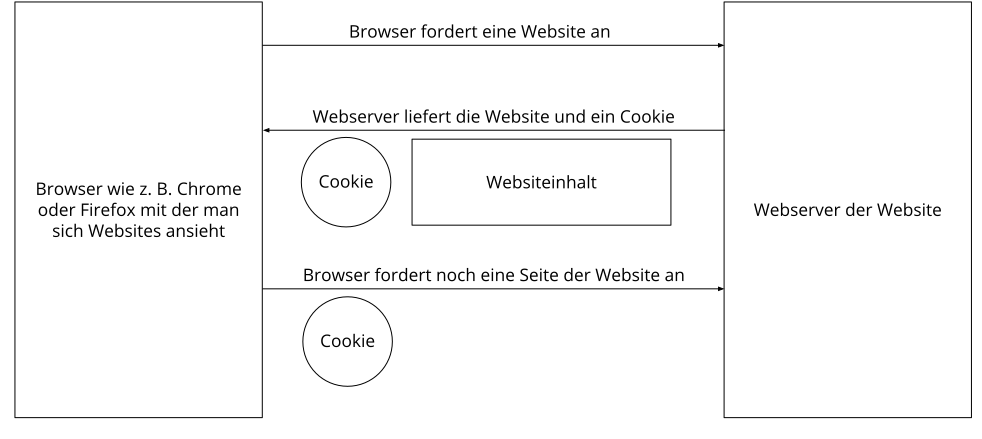
There are both first-party cookies and third-party cookies. First-party cookies are created directly by our site, while third-party cookies are created by partner websites (e.g., Google Analytics). Each cookie must be evaluated individually, as each cookie stores different data.
The expiration time of a cookie also varies from a few minutes to a few years. Cookies are not software programs and do not contain viruses, Trojans, or other "malware." Cookies also cannot access information on your PC.For example, cookie data might look like this:
Name: _ga
Value: GA1.2.1326744211.152323049738-9
Purpose: Distinguishing website visitors
Expiration date: after 2 years
A browser should be able to support these minimum sizes:
- At least 4096 bytes per cookie
- At least 50 cookies per domain
- At least 3000 cookies in total
What types of cookies are there?
The question of which specific cookies we use depends on the services used and will be clarified in the following sections of the privacy policy. At this point, we would like to briefly discuss the different types of HTTP cookies.
Four types of cookies can be distinguished:
Essential Cookies
These cookies are necessary to ensure basic website functions. For example, these cookies are needed when a user adds a product to their shopping cart, then continues browsing other pages, and only later proceeds to checkout. These cookies prevent the shopping cart from being deleted, even if the user closes their browser window.
Functional Cookies
These cookies collect information about user behavior and whether the user receives any error messages. These cookies are also used to measure the loading time and behavior of the website across different browsers.
Targeted Cookies
These cookies ensure better user-friendliness. For example, entered locations, font sizes, or form data are stored.
Advertising Cookies
These cookies are also called targeting cookies. They are used to deliver individually tailored advertising to the user. This can be very practical, but also very annoying.
Usually, when you visit a website for the first time, you will be asked which of these types of cookies you would like to allow. And, of course, this decision is also stored in a cookie.
If you would like to know more about cookies and are not afraid of technical documentation, we recommend https://datatracker.ietf.org/doc/html/rfc6265, the Request for Comments of the Internet Engineering Task Force (IETF) called "HTTP State Management Mechanism".
Purpose of data processing via cookies
The purpose ultimately depends on the respective cookie. You can find more details on this below or from the manufacturer of the software that sets the cookie.
Which data is processed?
Cookies are small helpers for many different tasks. Unfortunately, it is not possible to generalize which data is stored in cookies, but we will inform you about the data processed and stored in the following privacy policy.
Storage duration of cookies
The storage duration depends on the respective cookie and is specified further below. Some cookies are deleted after less than an hour, while others can remain stored on a computer for several years.
You also have control over the storage duration. You can manually delete all cookies at any time via your browser (see also "Right to object" below). Furthermore, cookies that are based on consent will be deleted at the latest after you withdraw your consent, whereby the legality of the storage until then remains unaffected.
Right to object - how can I delete cookies?
You decide how and whether you want to use cookies. Regardless of which service or website the cookies originate from, you always have the option to delete, deactivate, or only partially allow cookies.
For example, you can block third-party cookies but allow all other cookies.If you want to find out which cookies have been stored in your browser, or if you want to change or delete cookie settings, you can find this in your browser settings:
Chrome: Delete, enable, and manage cookies in Chrome
Safari: Manage cookies and website data with Safari
Firefox: Delete cookies to remove data that websites have stored on your computer
Internet Explorer: Delete and manage cookies
Microsoft Edge: Delete and manage cookies
CookiesIf you generally do not want cookies, you can configure your browser to always inform you when a cookie is about to be set. This allows you to decide for each individual cookie whether you want to allow it or not. The procedure varies depending on the browser. It is best to search for instructions on Google using the search term "delete cookies Chrome" or "disable cookies Chrome" in the case of a Chrome browser.
Legal Basis
The so-called "Cookie Guidelines" have been in effect since 2009. They stipulate that storing cookies requires your consent (Article 6, paragraph 1, letter a of the GDPR). However, there are still very different responses to these guidelines within the EU countries. In Austria, this directive was implemented in Section 165, paragraph 3 of the Telecommunications Act (2021). In Germany, the Cookie Guidelines were not implemented as national law. Instead, this directive was largely implemented in Section 15, paragraph 3 of the Telemedia Act (TMG), which has been replaced by the Digital Services Act (DDG) since May 2024.
For strictly necessary cookies, even if no consent is given, there are legitimate interests (Article 6, paragraph 1, letter f of the GDPR), which are in most cases of an economic nature. We want to provide website visitors with a pleasant user experience, and certain cookies are often absolutely necessary for this.
Insofar as non-essential cookies are used, this only happens with your consent. The legal basis in this respect is Article 6, paragraph 1, letter a of the GDPR.
In the following sections, you will be informed in more detail about the use of cookies, insofar as the software used employs cookies.
Web Hosting Introduction
|
Web Hosting Summary
👥 Data subjects: Website visitors 🤝 Purpose: Professional hosting of the website and ensuring its operation 📝 Processed data: IP address, time of website visit, browser used, and other data. More details can be found below or with the respective web hosting provider. 📅 Storage duration: depending on the respective provider, but usually 2 weeks ⚖️ Legal basis: Art. 6 para. 1 lit. f GDPR (Legitimate interests) |
What is web hosting?
When you visit websites these days, certain information – including personal data – is automatically created and stored, including on this website. This data should be processed as sparingly as possible and only with justification. By website, we mean the entirety of all web pages on a domain, i.e., everything from the homepage to the very last subpage (like this one). By domain, we mean, for example, example.de or sampleexample.com.
If you want to view a website on a computer, tablet, or smartphone, you use a program called a web browser. You are probably familiar with some web browsers by name: Google Chrome, Microsoft Edge, Mozilla Firefox, and Apple Safari. We simply call them browsers or web browsers.
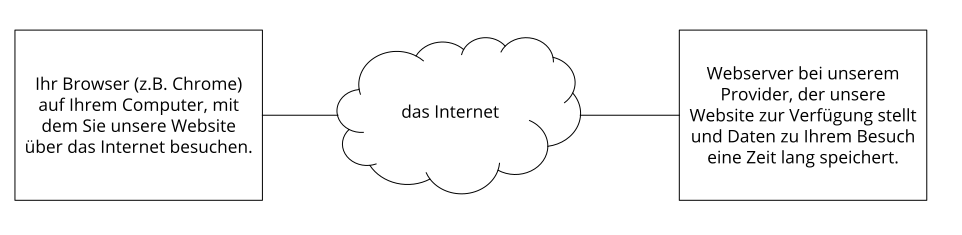
To display the website, the browser must connect to another computer where the website's code is stored: the web server. Operating a web server is a complicated and complex task, which is why this is usually handled by professional providers. These providers offer web hosting and thus ensure reliable and error-free storage of website data. A whole lot of technical terms, but please bear with us, it gets better!
When the browser on your computer (desktop, laptop, tablet, or smartphone) connects and during data transfer to and from the web server, processing of personal data may occur.
On the one hand, your computer stores data, and on the other hand, the web server also needs to store data for a certain period of time to ensure proper operation.A picture is worth a thousand words, so the following graphic illustrates the interaction between the browser, the internet, and the hosting provider.
Why do we process personal data?
The purposes of data processing are:
- Professional hosting of the website and securing its operation
- To maintain operational and IT security
- Anonymous analysis of access behavior to improve our services and, if necessary, for law enforcement or the pursuit of claims
What data is processed?
Even while you are currently visiting our website, our web server, which is the computer on which this website is stored, generally automatically saves data such as
- The complete internet address (URL) of the accessed website
- Browser and browser version (e.g., Chrome 87)
- The operating system used (e.g., Windows 10)
- The address (URL) of the previously visited page (referrer URL) (e.g., https://www.beispielquellsite.de/vondabinichgekommen/)
- The hostname and IP address of the device from which access is made (e.g., COMPUTERNAME and 194.23.43.121), however, the IP address is 100% anonymized by our hosting provider and replaced with 127.0.0.1 or ::1
- Date and time
- In files, the so-called web server log files
How long is the data stored?
As a rule, the data mentioned above is stored for two weeks and then automatically deleted.
We do not pass on this data, but we cannot rule out the possibility that this data may be viewed by authorities in the event of unlawful conduct.In short: Your visit is logged by our provider (the company that runs our website on special computers (servers)), but we do not pass on your data without your consent!
Legal Basis
The lawfulness of the processing of personal data within the scope of web hosting results from Art. 6 para. 1 lit. f GDPR (protection of legitimate interests), because the use of professional hosting with a provider is necessary to present the company securely and user-friendly on the internet and to be able to pursue attacks and claims arising therefrom if necessary.
A data processing agreement exists between us and the hosting provider manitu in accordance with Art. 28 et seq. GDPR, which ensures compliance with data protection and guarantees data security.
Cloud Services
|
Cloud Services Privacy Policy Summary
👤 Data subjects: We as website operators and you as website visitors 🤝 Purpose: Security and data storage 📝 Processed data: Data such as your IP address, name or technical data such as browser version More details can be found below and in the individual privacy texts or in the privacy policies of the providers 📅 Storage period: most data is stored until it is no longer needed to fulfill the service ⚖️ Legal basis: Art. 6 para. 1 lit. a GDPR (Consent), Art. 6 para. 1 lit. f GDPR (Legitimate interests) |
What are cloud services?
Cloud services provide us, as website operators, with storage space and computing power via the internet. Data can be transferred, processed, and stored on an external system via the internet. The respective cloud provider manages this data. Depending on the requirements, an individual or a company can choose the size of the storage space or computing power. Cloud storage is accessed via an API or via storage protocols. API stands for Application Programming Interface and refers to a programming interface that connects software and hardware components.
Why do we use cloud services?
We use cloud services for several reasons. A cloud service offers us the possibility to store our data securely. In addition, we have access to the data from various locations and devices, thus providing us with more flexibility and simplifying our work processes. Cloud storage also saves us costs because we do not have to build and manage our own infrastructure for data storage and data security. The central storage of our data in the cloud also allows us to expand our application areas and manage our information much better.
As website operators and as a company, we primarily use cloud services for our own purposes. For example, we use the services to manage our calendar, to store documents or other important information in the cloud. However, personal data from you may also be stored in the process. This is the case, for example, if you provide us with your contact details (such as name and email address) and we store our customer data with a cloud provider. Consequently, data that we process from you may also be stored and processed on external servers. If we offer certain forms or content from cloud services on our website, cookies may also be set for web analytics and advertising purposes.
What data is processed by cloud services?
Much of the data we store in the cloud is not personally identifiable, but some data, by definition of the GDPR, is considered personal data. This often includes customer data such as name, address, IP address, or telephone number, or technical device information. Videos, images, and audio files can also be stored in the cloud. How exactly the data is collected and stored depends on the respective service. We only try to use services that handle data in a very trustworthy and professional manner. Generally, services such as Amazon Drive have access to the stored files in order to provide their service accordingly. However, these services require permissions, such as the right to copy files for security reasons. This data is processed and managed within the scope of the services and in compliance with applicable laws. This also includes the GDPR for US providers (via standard contractual clauses). In some cases, these cloud services also cooperate with third-party providers who may process data under instruction and in accordance with the data protection guidelines and other security measures. We would like to emphasize again at this point that all well-known cloud services (such as Amazon Drive, Google Drive, or Microsoft OneDrive) obtain the right to access stored content in order to provide and optimize their own service accordingly.
Duration of data processing
We will inform you about the duration of data processing below, as soon as we have further information. In general, cloud services store data until you or we revoke the data storage or delete the data again. Generally, personal data is only stored for as long as it is absolutely necessary for the provision of the services. However, final data deletion from the cloud can take several months.
This is because the data is usually not only stored on one server, but is distributed across various servers.Right of Objection
You also have the right and the option to revoke your consent to data storage in a cloud at any time. If cookies are used, you also have the right to withdraw your consent here. This works either via our cookie management tool or via other opt-out functions. For example, you can also prevent data collection by cookies by managing, disabling, or deleting cookies in your browser. We also recommend our general privacy policy on cookies. To find out exactly what data of yours is stored and processed, you should read the privacy policies of the respective cloud providers.
Legal Basis
We primarily use cloud services based on our legitimate interests (Art. 6 para. 1 lit. f GDPR) in a good security and storage system.
Certain processing operations, in particular the use of cookies and the use of storage functions, require your consent. If you have consented to your data being processed and stored by cloud services, this consent serves as the legal basis for data processing (Art. 6 para. 1 lit. a GDPR). Most of the services we use set cookies in your browser to store data. Therefore, we recommend that you carefully read our privacy text on cookies and view the privacy policy or cookie guidelines of the respective service provider.
Information on specific tools can be found – if available – in the following sections.
Google Cloud Privacy Policy
We use Google Cloud for our website, an online storage service for files, photos, and videos. The service provider is the American company Google Inc. For the European region, Google Ireland Limited (Gordon House, Barrow Street Dublin 4, Ireland) is responsible for all Google services.
Google processes your data, among other things, also in the USA. Google is an active participant in the EU-US Data Privacy Framework, which regulates the correct and secure transfer of personal data of EU citizens to the USA. You can find more information on this at https://commission.europa.eu/document/fa09cbad-dd7d-4684-ae60-be03fcb0fddf_en.
In addition, Google uses so-called standard contractual clauses (= Art. 46, paragraphs 2 and 3 of the GDPR). Standard Contractual Clauses (SCCs) are model templates provided by the EU Commission and are intended to ensure that your data complies with European data protection standards even when it is transferred to and stored in third countries (such as the USA). Through the EU-US Data Privacy Framework and the standard contractual clauses, Google commits to maintaining the European level of data protection when processing your relevant data, even if the data is stored, processed, and managed in the USA. These clauses are based on an implementing decision of the EU Commission.
You can find the decision and the corresponding standard contractual clauses here, among other places: https://eur-lex.europa.eu/eli/dec_impl/2021/914/oj?locale=deGoogle provides a data processing agreement in accordance with Art. 28 GDPR, which serves as the legal basis for our customer relationship with Google. This agreement refers to the EU standard contractual clauses. You can find the data processing terms here: https://business.safety.google/intl/de/adsprocessorterms/
You can find out more about the data processed through the use of Google Cloud in the Privacy Policy at https://policies.google.com/privacy?hl=de.
Concluding remarks
Congratulations! If you are reading these lines, you have truly "fought" your way through our entire privacy policy, or at least scrolled this far. As you can see from the length of our privacy policy, we take the protection of your personal data very seriously.
It is important to us to inform you to the best of our knowledge and belief about the processing of personal data. In doing so, we not only want to tell you which data is processed, but also explain the reasons for using various software programs. Privacy policies usually sound very technical and legalistic. However, since most of you are neither web developers nor lawyers, we wanted to take a different approach in terms of language and explain the matter in simple and clear terms. This is not always possible due to the subject matter. Therefore, the most important terms are explained in more detail at the end of the privacy policy.
If you have any questions about data protection on our website, please do not hesitate to contact us or the responsible party. We wish you a pleasant time and hope to welcome you back to our website soon.
All texts are protected by copyright.
Source: Privacy Policy created with the Privacy Policy Generator for Germany by AdSimple. Also take a look at our sample privacy policy.
